Engineering Inspiration: National Webinar Series Celebrates Engineers Week 2026
To mark Engineers Week 2026, Curious Minds, SEAI, and ESERO Ireland teamed up to deliver Engineering Inspiration, a four-day webinar series designed for Primary School students (3rd-6th Class).
The series introduced classrooms across Ireland to the world of engineering through real stories from professionals working at the cutting edge of energy, transport, space, and sustainability. Each day highlighted a different engineering pathway, showing students how varied and exciting the field can be.
Teachers and students can also access a FREE complimentary activity booklet here for Engineers Week 2026, which is packed with hands-on challenges and classroom resources.
Each webinar has been recorded for you to watch back in this YouTube playlist.
Tuesday: Engineering Big Ideas with Fiona Lavin
The week opened with Fiona Lavin, who explored how lasers, deep‑ocean data cables, and Ireland’s largest energy‑using companies have all shaped her engineering journey.
Now part of SEAI’s Large Business Decarbonisation team, Fiona works with some of the country’s major energy users to reduce emissions and accelerate Ireland’s clean‑energy transition.
Drawing on her earlier work as a research engineer where she developed laser technologies and worked on data cables stretching thousands of miles across the ocean, Fiona showed students how complex systems can be redesigned for sustainability.
Wednesday: Smarter Energy and Transport with Shane Prendergast
Mid‑week, classes met Shane Prendergast, Programme Manager at SEAI, who posed a powerful question: How can cars, home appliances, and mobile phones work together to fight climate change?
With a background in Aeronautical Engineering and experience certifying vehicle technologies at the National Standards Authority of Ireland, Shane now helps expand Ireland’s electric vehicle charging network and develop smarter ways to use energy.
His session highlighted how engineering can transform communities, enabling people and businesses to become confident, flexible energy users.
Thursday: Space Engineering Adventures with Maeve Doyle
On Thursday, students headed to space with Maeve Doyle, a flight software verification and validation engineer working in space sustainability.
Maeve tests satellite software to ensure spacecraft operate exactly as intended once launched. Growing up her passion for astronomy led her to study physics and astrophysics before joining cutting‑edge projects such as EIRSAT‑1, Ireland’s first satellite.
She has also worked as a Fleet Operations Engineer, helping manage a constellation of more than 600 satellites orbiting Earth. Maeve’s talk demonstrated how programming, physics, and curiosity can come together in a space engineering career.
Friday: Innovation from Lab to Ocean with Kerrie Sheehan
The series concluded with Kerrie Sheehan, SEAI’s Head of Research, Innovation and Electricity. Kerrie gave students a glimpse into a career where no two days look alike, from testing tiny e‑bike sensors in the lab to supporting trials of wave‑powered buoys in the Atlantic.
Kerrie leads Ireland’s national energy research programme, supporting pioneering projects across offshore energy, renewable heat, electric vehicles, and more. Her session showed how engineers bring ideas from early design stages through to testing and real‑world deployment.
Explore More: Free Activity Booklet
Teachers can continue the learning with our FREE Engineers Week 2026 Activity Booklet, created to complement the webinar series with fun, curriculum‑linked engineering challenges.
Download the accompanying Resource!
Humanity Returns to the Moon: Artemis II Updates, Rosemary Coogan’s Journey, and How Students Can Join the Adventure Through Moon Camp
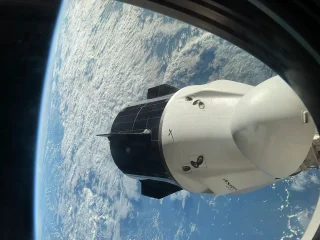
Humanity is getting ready to take another big step toward the Moon, and Europe is firmly part of that story.
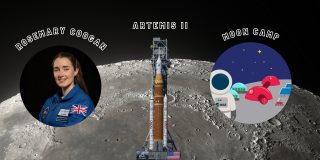
As NASA prepares for the Artemis II mission, European Space Agency (ESA) astronaut Rosemary Coogan continues her journey toward space, and thousands of students across Europe are invited to design their own off‑world habitats through Moon Camp.
Here’s how all three threads come together in a moment of renewed excitement for lunar exploration.
Artemis II: A Mission Worth Waiting For
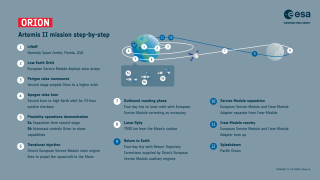
NASA’s Artemis II mission, the first crewed trip around the Moon in more than 50 years, has hit a few bumps on the road to launch, but progress continues. During a full ‘wet dress rehearsal’, engineers identified a persistent liquid hydrogen leak, along with some audio communication dropouts and weather-related delays. Because of those issues, NASA has now shifted the earliest launch window to March 2026.
Even with the delay, excitement remains high. The mission will see astronauts Reid Wiseman (NASA), Christina Koch (NASA), Victor Glover (NASA), and Jeremy Hansen (CSA – Canadian Space Agency) fly a 10‑day loop around the Moon to test spacecraft systems that are critical for future lunar landings. Although Artemis II won’t touch down on the Moon’s surface, it sets the stage for Artemis III, and ultimately for a sustained human presence on the Moon. This is very much a global story beyond Europe, the United States and Canada, as countries such as China (who are planning a crewed lunar landing by 2030) and emerging players like the UAE, Japan, and India are also advocating ambitious plans to send their own astronauts or missions toward the moon in the coming decades.
Rosemary Coogan: A New European Voice in Space Exploration
Among the next generation of European explorers is Dr. Rosemary Coogan, an ESA astronaut candidate originally from Belfast. She brings an inspiring mix of scientific expertise and down‑to‑earth enthusiasm for space. Coogan holds master’s degrees in physics and astronomy from Durham University, as well as a PhD in astronomy from the University of Sussex. She has applied the knowledge she has gained to research at top institutions such as the Max Planck Institute for Extraterrestrial Physics in Germany and CNES (the French Space Agency).
Her astronaut training has already taken her through winter survival exercises in the Pyrenees, spacewalk practice underwater in NASA’s Neutral Buoyancy Laboratory, centrifuge and microgravity flights, and international systems training aboard replica ISS modules. She speaks openly about how the immensity of space captured her imagination as a child, and she continues to inspire young people today by sharing her journey at events across Ireland. Her first mission is expected to be to the ISS by 2030, but like many in ESA’s new astronaut class, she may well play a role in Europe’s contribution to future lunar missions!
Moon Camp: Where Students Become Space Designers
Meanwhile, the next wave of future scientists, engineers, and astronauts may already be getting their start through Moon Camp. ESA’s hands‑on imaginative education challenge invites young people up to 19 years old to design their own space habitat, whether on the Moon, Mars, or another planet or moon in the Solar System. Projects can take almost any form, from hand-built models to VR worlds, robotics or scientific experiments. Submissions close the 27th of July 2026, and every team receives an ESA participation certificate.
Moon Camp is designed to be flexible for teachers and educators, with classroom‑ready resources and inspiration from real ESA experts and astronauts. It is run in partnership with ESERO offices across Europe and the Airbus Foundation to help students build creativity, teamwork, and problem‑solving skills, while imagining what life could look like beyond Earth.

Looking Ahead
With Artemis II preparing for launch, astronauts like Rosemary Coogan moving closer to their first missions, and Moon Camp inviting students to dream up the future of living in space, Europe is playing an active and inspiring role in this new era of lunar exploration.
2025 Science Week Activity Pack for Schools
ESERO Ireland and Science Week have put together a Post-Primary Activity Pack to celebrate Science Week.

Welcome to Science Week, November 9th – 16th, 2025
It’s that time of year again, ESERO Ireland and Research Ireland are inviting post-primary schools to take the leap and get involved in Science Week!
Get ready for an exciting Science Week. This year we are celebrating 30 years of Science Week with the theme Then. Today. Tomorrow.
This gives us an opportunity to explore what we have learned from scientific discoveries in the past, amazing research taking place right now, and what the world might look like in the future and how it may be shaped by science and technology.
We’ve planned some fun activities for you to join in and get thinking about how we may live in the future – and where we might live. Let’s get exploring and celebrate our amazing strengths!
Join the conversation, see what’s happening and share your Science Week celebrations using #ScienceWeek or tag @ResearchIreland
Primary Level Activity Pack
There is also a Science Week Primary Activity Pack developed by Curious Minds and Science Week which you can find on the Curious Minds website.

Back to School 2025-2026: 5 projects to inspire your students
This year, take your students’ learning beyond the classroom and into space!
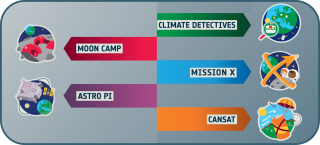
The school-level projects, run by ESA and ESERO Ireland, immerse students in activities that mirror the collaborative, cross-disciplinary nature of real space missions. The projects not only deepen students’ understanding of science, technology, engineering, and mathematics (STEM) subjects, but also help them develop essential skills and competences in teamwork, problem-solving, and critical thinking.
Get to know the 5 projects
With the projects, students can run their codes in space, design a space habitat, build and launch soda can-sized satellites, investigate Earth’s environment, and even train like an astronaut!
Explore each project, check key dates and find the perfect activity to discover with your students.
Astro Pi
Find out more about Astro Pi, what is involved, and how to take part.
Suitable for primary and secondary level students, with Mission Zero and the more advanced Mission Space Lab.
Moon Camp
Find out more about Moon Camp, what is involved, and how to take part.
Suitable for primary and secondary level students, challenging students up to 19 years old to design space habitats.
CanSat
Find out more about CanSat, what is involved, and how to take part.
Suitable for secondary level students at Transition Year and Senior Cycle, working in teams to build and launch a satellite the size of a soft drinks can.
Climate Detectives
Find out more about Climate Detectives, what is involved, and how to take part.
Suitable for primary and secondary level students, with Climate Detective Kids for primary classes and the more advanced Climate Detectives for second level classes.
Mission X
Find out more about Mission X, what is involved, and how to take part.
Suitable for primary level students to engage in science through astronaut-style training.
Back Down to Earth
EIRSAT-1’s mission comes to an end.
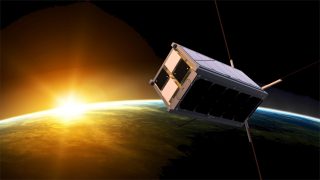
Ireland’s first satellite finished its mission and de-orbited yesterday, 4th September 2025, after almost two years in space. EIRSAT-1 was built and operated by students and staff at University College Dublin as part of the ESA Fly your Satellite! programme.
The small satellite was launched in December 2023 and during its time in orbit, EIRSAT-1 carried out three experiments designed in Ireland, including studying bursts of energy from space, testing new satellite control methods, and trying out special protective coatings.
The mission gave more than 50 students hands-on experience of designing, building, and running a real spacecraft, marking a historic step for Ireland as a spacefaring nation.
For more information visit: https://www.ucd.ie/newsandopinion/news/2025/september/03/missionaccomplishedeirsat-1todeorbitaftertwoyearhistoricjourney/
ESERO Ireland and BCO celebrate Kildare students representing Ireland at ESA CanSat event
ESERO Ireland and MTU’s Blackrock Castle Observatory (BCO) congratulate four students from Confey College in Co. Kildare who recently represented Ireland at the prestigious European Space Agency (ESA) CanSat event held at the European Space Research and Technology Centre (ESTEC) in the Netherlands.
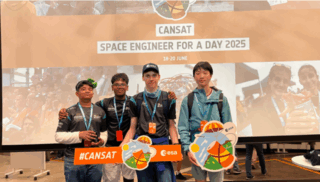
The students were invited to join 25 national winners from across Europe at the annual ‘Space Engineer for a Day’ event to showcase their innovative satellite project and take part in hands-on learning with leading space engineers.
Funded and supported by ESERO Ireland and Research Ireland, the CanSat competition is a STEM initiative run nationally by MTU’s Blackrock Castle Observatory. In partnership with Technological Universities (TUs), who provide critical technical mentorship, access to laboratory facilities and ongoing support to schools, the competition challenges second-level students to design, build, and test satellites built inside soft drink cans. This helps students to develop skills in engineering, programming and teamwork.
Confey College’s winning project included features such as particle and gas sensors, solar-powered battery recharging, and SMS messaging technology which shows one of the actual space mission challenges. Their project successfully processed scientific data during a 300-metre rocket drop test.
Alan Giltinan, Manager, Blackrock Castle Observatory, said: “We at Blackrock Castle Observatory are proud to support young people across Ireland in their journey to become the next generation of space engineers and scientists. Through CanSat, we provide students with opportunities to develop their STEM skills, solve real engineering problems and get exposure to Europe’s space sector. The Confey College team’s success at ESTEC is a testament to their dedication and the value of this programme.”
“CanSat is a unique challenge that builds resilience, creativity and collaboration in students. The trip to ESTEC offered invaluable insight into the space industry and inspired our students to pursue STEM careers.”
Mary Selkirk, teacher and mentor at Confey College, praised the competition’s impact
Brendan Owens, Research Ireland and ESERO Ireland, said: “CanSat is a wonderful opportunity for students to get involved in real-world space science applications when designing, building, and programming their CanSat, as well as then analysing the data gathered. This Space Engineer for a Day event is a valuable reward, and we would love to see more schools and teams signing up to participate for the 2025-2026 competition from September, as well as taking part in the many other ESERO school projects.”
“I had a fantastic trip to the Netherlands where I gained valuable insights into space technology, particularly ESA’s future lunar missions. I also learned about the ideas and innovations of other teams. This CanSat competition was a great challenge and success. As the team’s parachute specialist, I improved my problem-solving skills and my teamwork abilities.”
Eason Zhu, from the winning team
CanSat takes place annually and the national winning team earns the opportunity to participate in ESA’s prestigious ESTEC event the following June. ESERO Ireland and MTU Blackrock Castle Observatory look forward to supporting the next generation of innovators and invite schools to apply for the 2026 competition.
For more information or to apply, visit our CanSat project page.
From Concept to Launch: University Teams Fly Experiments on Sounding Rockets
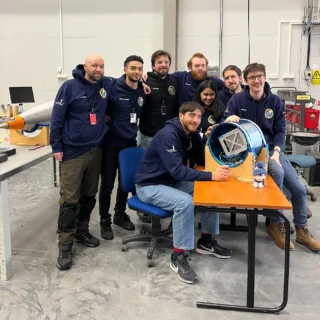
From 3–15 March 2025, 74 university students travelled to Esrange Space Center in northern Sweden to launch their experiments onboard two sounding rockets, REXUS 33 and REXUS 34, as part of the Swedish-German REXUS/BEXUS programme. The students represented eight experiment teams from universities in Germany, Romania, Hungary, and Sweden.
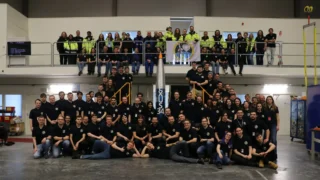
The teams were selected to participate in the programme in 2023 and spent the following 18 months developing their experiments—from initial concepts to fully integrated flight hardware. Throughout this process, the student teams received guidance and support from experts of the Swedish National Space Agency (SNSA), the German Aerospace Center (DLR), the European Space Agency (ESA), the Swedish Space Corporation (SSC), the Center of Applied Space Technology and Microgravity (ZARM), and DLR’s Mobile Rocket Base (MORABA).
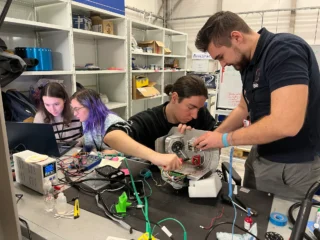
During the launch campaign, the teams conducted final preparations, including rigorous system checks and last-minute adjustments to ensure their experiments were ready for flight. Some teams encountered technical challenges, ranging from mechanical and electrical issues to software troubleshooting, but their persistence and teamwork enabled them to resolve the problems and proceed with the campaign.
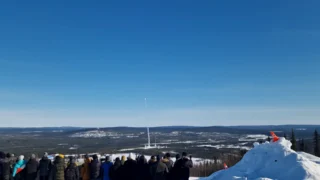
On 11 March, at 10:15 AM CET, the first rocket, REXUS 33, successfully lifted off, reaching an apogee of approximately 78 km. It carried three student experiments:
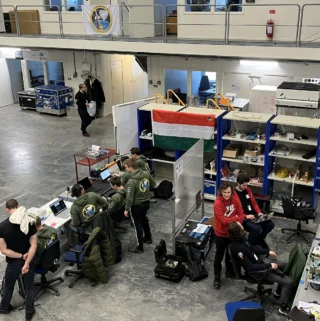
- PERSIS (Photopolymeric Extrusion of Reinforced Structures In Space) from the Munich University of Applied Sciences, Germany.
- SOLDERx (Soldering Operations in Low-Gravity Environments for Research and Exploration) from the University Politehnica of Bucharest, Romania.
- WOBBLE2 (Weightless Observation of Fluid Behaviour with Berlin Liquid Guidance Experiment) from the Technical University of Berlin, Germany.
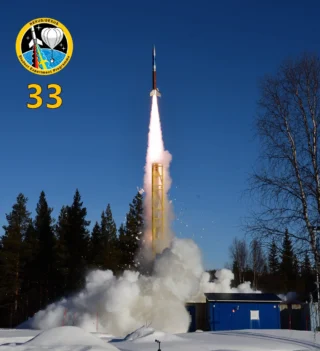
Two days later, on 13 March, at 06:23 AM CET, the second rocket, REXUS 34, was launched. However, the mission encountered a non-nominal flight. Despite this, the student teams are now focusing on analysing their data and evaluating the results of their experiments.
The experiments on board REXUS 34 were the following:
- FENRIR (Free fall Experiment uNit for Reduced-gravity Investigations and Research) from the Luleå University of Technology, Sweden.
- FINIX (Ferrofluid Implementations for Next GeneratIon Exploration) from the Stuttgart University, Germany.
- SHAMA (Sustainable Heat protective Ablative Material) from the Dresden University of Technology, Germany.
- SLOSH (Sloshing Experiment) from the Augsburg University, Germany.
- TELLER (Three-axis Experimental Low-altitude Laboratory for Exploring Radiation) from the Budapest University of Technology and Economics, Hungary.
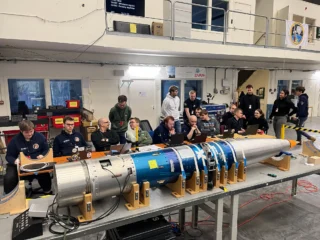
On the final day of the campaign, all teams presented their preliminary results in a post-flight meeting. Now back home, the students will dive deep into their data and prepare a final reporting of their findings.
Each year, two rockets and two balloons are launched within the REXUS/BEXUS programme, carrying up to 20 student-built experiments. A new call for proposals will open in June 2025, offering the next generation of university students an opportunity to design and launch their own experiments. More information on the application process.
The REXUS/BEXUS programme is realised under a bilateral Agency Agreement between the German Aerospace Center (DLR) and the Swedish National Space Agency (SNSA). The Swedish share of the payload has been made available to students from other European countries through a collaboration with the European Space Agency (ESA). EuroLaunch, a cooperation between the Swedish Space Corporation (SSC) and the Mobile Rocket Base (MORABA) of DLR, is responsible for the campaign management and operations of the launch vehicles. Experts from DLR, SSC, ZARM and ESA provide technical support to the student teams throughout the project. REXUS and BEXUS are launched from SSC, Esrange Space Center in northern Sweden.
Kicking off the CubeSat Support Facility 2025 activities: Thermal Balancing with 6S
6S – a 1U CubeSat currently being developed by the PoliSpace student organisation of Politecnico di Milano, Italy – was selected for the October 2024 test window of the Fly Your Satellite! (FYS!) Test Opportunities. Their CubeSat was therefore Vibration tested on October while the Thermal Balance test was performed on late February 2025.
Having participated in the Fly Your Satellite! Design Booster programme, the 6S team demonstrated the range of opportunities FYS! provides to support teams across all phases of their projects, from design and manufacturing to testing.
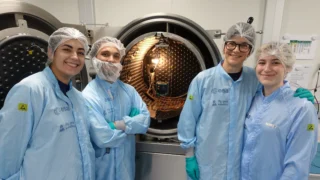
Following their selection, they successfully tested their Structural-Thermal Model (STM) in a Thermal Balance Test campaign from 24 to 28 February 2025, at the CubeSat Support Facility located at ESEC Redu, Belgium.
In-depth
After being selected for the FYS! Test Opportunities program, the PoliSpace student organization from Politecnico di Milano successfully conducted their thermal balance test campaign on the 1U CubeSat STM, following their previous successes with the vibration campaign. The test took place from February 24 to 28, 2025.
This test campaign served two crucial purposes:
- To assess the Structural-Thermal Model (STM) of the CubeSat under thermal stress, revealing any design weaknesses before qualifying it for launch.
- To generate sufficient data for Thermal Mathematical Model and Analysis correlation, ensuring accurate validation of thermal simulations.
Four dedicated team members travelled from Milan to ESA-ESEC in Belgium to carry out this test, reflecting their commitment to pushing the boundaries of space technology while gaining real-world exposure to a complete satellite development cycle.
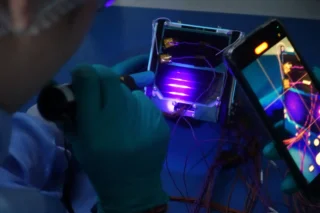
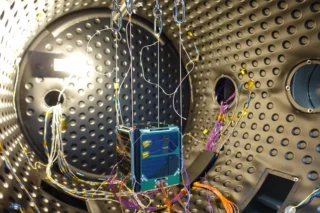
At the CubeSat Support Facility, the team prepared their dummy satellite bus together with heaters that would represent the expected heat dissipation of their subsystems per mode of operation. Multiple thermocouples (a kind of temperature sensor) were placed to measure the various temperatures from critical points. The tests provided crucial insights into how their satellite responds to the changing environment, reinforcing their understanding on how the system will respond.
Thanks to the FYS! Test Opportunities programme, students from Politecnico di Milano gained hands-on experience in executing high-level testing campaigns, mastering documentation, and adhering to strict laboratory protocols. This week’s results not only highlight the demanding nature of the space environment but also emphasise the need for skilled professionals in Europe’s growing space industry.
We are very excited to kick off 2025 with this successful campaign and we wish best of luck to PoliSpace team and their amazing 6S project.
Beyond satellite projects, these test opportunities extend to a broader audience, including sounding rocket teams and participants in ESA Academy experiments, fostering innovation across multiple disciplines.